Blog

  • Exploring Pakistan’s Leather Exports: A Guide on How to Run a Leather Export Business on Amazon

    Exploring Pakistan’s Leather Exports: A Guide on How to Run a Leather Export Business on Amazon

    Exports of leather and goods are experiencing a significant surge in the international market, holding promising implications for the people of Pakistan. This upswing presents numerous potential benefits, and we’d like to outline how you can capitalize on this positive trajectory.

    As indicated by the Pakistan Bureau of Statistics (PBS), Pakistan’s exports of leather and goods witnessed an impressive growth of 10.94% during the fiscal year 2022-23 (July-June). Specifically, the export of goods displayed noteworthy increases: sports goods exports surged by 17.8% to reach $306.1 million, while leather goods exports grew by 5.1% to attain $98.697 million.

    These figures underscore the substantial opportunities within the global market for sports and leather goods. Notably, in terms of international trade, the United States of America emerges as a pivotal player due to its robust and flourishing economy.

    In the context of leather goods, the top five export destinations encompass the United States, the European Union, and China.

    This escalating trend in exports not only demonstrates Pakistan’s potential to cater to international demand for these goods but also opens avenues for economic growth and prosperity. By harnessing these opportunities and tapping into the evolving preferences of global consumers, Pakistan stands to achieve considerable economic gains in the realm of leather and goods trade.
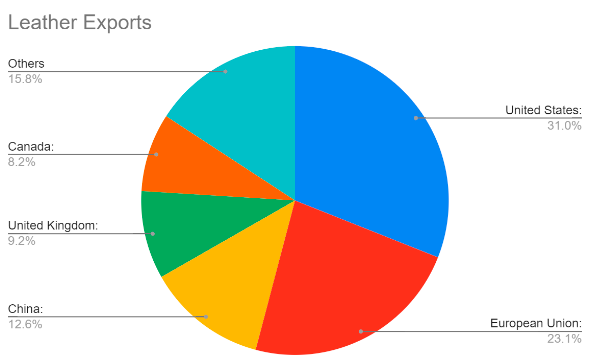
    Leather Exports Across the world form Pakistan

    The vibrant tapestry of leather exports includes a diverse array of items, highlighting Pakistan’s craftsmanship. These items include:

    • Leather garments, such as jackets, coats, pants, skirts, bags, gloves, wallets, and belts.
    • Leather shoes, for fashion and various purposes.
    • Leather furniture, car seats, and travel essentials.

    The growth of the leather industry can be attributed to three factors:

    • Global demand: The global market is increasingly demanding leather goods.
    • Skilled workforce: Pakistan has a skilled workforce that can produce high-quality leather products.
    • Government support: The government has provided strategic support and encouragement to the leather industry.

    The future of this industry looks bright, with continued growth expected. This growth will create jobs and boost the economy of Pakistan.

    How Pakistanis Can Benefit from this Rising Demand

    The demand for leather products is very high. According to a report by Grand View Research, the global leather goods market is expected to reach USD 754 billion by 2028, growing at a CAGR of 7.4% from 2021 to 2028.

    If you are interested in tapping into the leather goods market, there are numerous resources available to help you. The Leather Industry Development Council of Pakistan (LIDCP) is a government agency that provides support to the leather industry. The LIDCP offers training programs, financial assistance, and market research.

    There is also the Pakistan Leather Export Council (PELC), a trade association that represents the leather goods exporters of Pakistan. The PELC offers a number of services to its members, such as market research, training programs, and export promotion.

    In addition, there is a huge opportunity for Pakistani sellers to start doing leather business on Amazon. Amazon is the world’s largest online retailer and has a huge customer base. This means that there is a large potential market for Pakistani leather goods on Amazon.

    In addition, Amazon offers a number of features that make it a great platform for selling leather goods. These features include:

    • A large customer base: Amazon has over 300 million active customers worldwide. This means that your leather goods will be exposed to many potential buyers.
    • Global reach: Amazon ships to over 185 countries. This means that you can sell your leather goods to customers all over the world.
    • Fulfillment by Amazon (FBA): FBA is a service that allows you to store your products in Amazon’s warehouses and have them shipped to customers when they order. This can save you time and money on shipping.
    • Seller Central: Seller Central is a platform that allows you to manage your Amazon business. This includes things like listing your products, tracking orders, and managing payments.

    How Amazon is Growing In Pakistan

    Amazon is a key player in enabling business growth in Pakistan. The meteoric rise of Amazon FBA sellers and Amazon affiliate marketers in the country is a testament to this. In 2022, Amazon FBA sellers in Pakistan generated a collective sales value of $100 million. On average, Amazon FBA sellers earned around $2,000 per month, while Amazon affiliate marketers earned a respectable $500 monthly.

    The Amazon FBA community in Pakistan is projected to expand to 100,000 sellers by 2025. The Amazon affiliate marketing arena is also expected to grow to 50,000 participants during the same period.
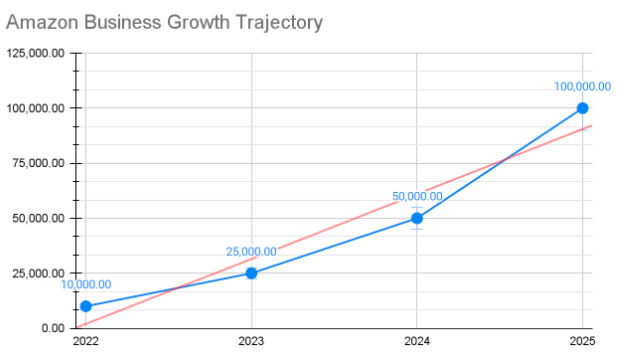
    amazon business growth trajectory

    How You Can Register a Business On Amazon and what documents are required for it.

    There are two ways to register a business on Amazon:

    Individual Seller Account: This is the most common type of account and is suitable for sellers who are selling products that they have manufactured or sourced themselves. To register for an Individual Seller Account, you will need to provide the following information:

    • Your name and address
    • Your bank account information
    • Your tax identification number (TIN)
    • Your credit card information

    Professional Seller Account: This type of account is suitable for sellers who are selling products on a larger scale or who need to sell products that are restricted on the Individual Seller Account, such as alcohol or tobacco. To register for a Professional Seller Account, you will need to provide the same information as for an Individual Seller Account, as well as the following:

    • A business license
    • A resale certificate
    • A tax exemption certificate (if applicable)

    Once you have registered for a Seller Account, you will need to provide Amazon with documentation to verify your identity and business information. The specific documents required will vary depending on your country or region.

    Here are some of the documents that you may need to provide:

    Government-issued ID: This can be a driver’s license, passport, or other government-issued ID that shows your name, date of birth, and photo.

    Business documents: This can vary depending on the type of business you have, but it may include a business license, tax identification number (TIN), or articles of incorporation.

    Proof of address: This can be a utility bill, bank statement, or other document that shows your current address.

    If you are a sole proprietor, you will also need to provide a Schedule C tax form from your most recent tax return. If you are a limited liability company (LLC), you must furnish your operating agreement. Upon thorough review and approval, Amazon Seller Accounts receive the coveted verification status.

    How to register LLC from Pakistan

    Here are some additional documents that might be sought under specific circumstances:

    Bank Statements: Required for fresh bank accounts engaged in Amazon business.

    Invoices: Essential for products not manufactured in-house.

    Origin Certification: Mandatory for products imported, particularly into the United States.

    What you need to do to export from Pakistan to the United States:

    • Obtain an export license: If you are exporting restricted products, you will need to obtain an export license from the Export Promotion Bureau (EPB). You can check with the EPB to see if the products you want to export are restricted.
    • Meet US import requirements: You will need to meet the import requirements of the United States. This includes things like declaring the value of your goods, paying any applicable duties and taxes, and following the correct packaging and labeling requirements. You can find more information about US import requirements on the website of the United States Customs and Border Protection (CBP).
    • Find a reliable freight forwarder: A freight forwarder will help you book shipping space, arrange customs clearance, and track your shipment. They can also help you with the documentation and paperwork required to export to the United States.

    However, if you are worried about the documentation and the complicated processes, which is the only hurdle in making your dream a reality, then Befiler is there to help you out.

  • Why Should You Form an LLC for Your Amazon or Drop-shipping Business?

    Why Should You Form an LLC for Your Amazon or Drop-shipping Business?

    If you’re considering selling on Amazon or, forming an LLC is wise, as it unlocks many potential benefits for your Amazon FBA or drop-shipping business. An LLC can help you protect your assets, comply with Amazon’s business verification requirements, and demonstrate professionalism to Amazon and other Drop-shipping giants. Here you will gain significant knowledge on steps to register your LLC in the USA, who are the leading market giants in Drop-shipping, and how their compliance is different from each other.

    Why Should You Form an LLC for Your Amazon FBA and Affiliated or Drop-shipping Business?

    Steps to form an LLC:  

    Choose a state where you want to form an LLC:

    You have to choose the state where you want to register your LLC. However, you can form an LLC in any condition, even if the LLC won’t be doing any business there. 

    Registered agent:

    In forming an LLC in a foreign state, you must have a registered agent in the state of formation or qualification.

    Name of your LLC:

    To form an LLC, you’ll have to choose a name not already on the Secretary of State’s records as the name of another domestic or qualified LLC or other business entity.

    Article of organization:

    To form your LLC, you must submit to the state articles of organization, also called a certificate of organization (or certificate of formation in some states). 

    It consists of the following documents;

    • Business name
    • Business purpose 
    • Duration 
    • primary business purpose
    • Ownership
    • Management 
    • Registered Agent

    Tax registration:

    Your LLC must register with the revenue department in many states for one or more tax types. These may include general, employer taxes, and sales and use taxes.

    EIN (Employer Identification Number):

    Obtaining an EIN is vital for tax and identification purposes. Amazon may request this as part of your business verification process.

    Navigating Drop-Shipping Giants: Key Compliance Factors to Keep in Mind

    Amazon:

    According to Amazon 889 compliance, you must register your LLC to avoid any extra tax deduction. Nothing other than an LLC will be your only option if you want to operate your firm without a third-party investor and at the same time with minimal personal liability.

    Oberlo:

    Test out new products and prices without splashing cash upfront. No big-cost bulk buy. No box stacking in your living room. No rolls of sticky tape and shipping labels. Drop-shipping is digital. You build your online store and do the selling. Your suppliers sort the inventory and ship orders directly to your shoppers. There are only paying suppliers once your customers pay you.

     That’s the sweet spot. You buy at one price and sell at another.https://www.oberlo.com/dropshipping

    Suppose you want to start your drop-shipping business on Oberlo from Pakistan. In that case, you must register your LLC as soon as possible, as it gives you two significant benefits: personal liability protection and tax reduction. If you’re the sole owner of your business, an LLC can provide personal liability protection, and having an LLC will save you from any extra tax reduction.

    SaleHoo:

    You don’t need to engage in a guessing game with suppliers. SaleHoo has already screened over 8,000 suppliers and offers over 2.5 million products. This means you can confidently start building your drop-shipping business, knowing that the suppliers and products have been thoroughly vetted. https://www.salehoo.com/about-us 

    Suppose you want to start your drop-shipping business from Pakistan on Salehoo. In that case, you must register your LLC as it is the first requirement from Salehoo Writing LLC will save you from extra tax deductions as Salehoo requires you to have your proper business details, which include your NTN number, your tax registration, and many more all this information you can have by register your LLC as soon as possible.

    Dropified:

    Dropified is a software application that allows you to easily import and manage dropshipped products into your favorite e-commerce platform (like WooCommerce, Shopify, and others) and then ship those products you’ve sold directly to your customers, wherever they may live on this planet – in only a few clicks without EVER physically touching the product. https://www.dropified.com/about-us/ 

    To register as a drop shipper from Pakistan on Dropified, you must register LLC, an essential and significant requirement from Dropified. Because they require the business name and NTN number, you can gain all this from writing your LLC.

    Printful:

    Printful Utilizes a print-on-demand (POD) business approach, which operates in the following manner: You create an e-commerce store and offer products showcasing your unique designs. 

    When a sale is made, Printful manages all production aspects, including printing the designs on the chosen items, packaging the products, and handling the shipping to customers. This simplifies the operational and technical responsibilities of running an online store, allowing you to concentrate on your business’s creative and promotional aspects. 

    You have to register an LLC to start your business on Printful https://www.printful.com/blog/how-to-start-a-business-in-usa as it’s an essential requirement from Printful. And if you’re from Pakistan and you want to register yourself to print, then you have to register your LLC and can have your NTN and other business requirements.

    Modalyst:

    Modalyst is a drop-shipping site where you can sell your product worldwide. Modalyst is positioned as the future of dropshipping, offering a platform for creators and merchants to efficiently manage and grow their eCommerce brands using top-notch print-on-demand services and drop-shipping tools. This enables businesses to customize products and fulfill orders without stocking inventory. 

    As modalist requires your US address and taxation requirements https://support.modalyst.co/en/articles/1005258-what-is-the-application-process-for-becoming-a-supplier so if you’re in Pakistan and want to start your drop-shipping business so, what you have to do? Don’t panic; you need to register your LLC, and you’ll complete all the requirements to start your drop-shipping.

    What’s next?

    You don’t need to worry about how to get an EIN or where to go to open your USD bank account Because you can now contact Befiler through our live chat support and get yourself an LLC in just a matter of a few days. Befiler offers a complete package that includes company formations, EIN, and US Bank Account, saving you work hours. 


  • PSEB Registration: Benefits for Freelancers and Software Houses in Pakistan

    PSEB Registration: Benefits for Freelancers and Software Houses in Pakistan

    The Pakistan Software Export Board (PSEB) is a government agency that promotes the growth of Pakistan’s IT and ITeS (Information Technology and Information Technology-enabled Services) sectors. PSEB offers several benefits to registered freelancers and software houses, including tax breaks, government programs, incentives, improved credibility and visibility, and access to international markets.

    Tax Benefits

    One of the most significant benefits of Pakistan Software Export Board (PSEB) registration is a deduction of 0.25% tax on export receipts received in Pakistan, as opposed to 1% for freelancers and software houses that are not registered with PSEB. This means that PSEB registered freelancers and software house can save a good amount of money on their taxes.

    Access to Government Programs and Incentives

    PSEB registered freelancers and software houses are eligible for several government programs and incentives, such as subsidized training, access to government procurement contracts, and export financing. These programs and incentives can help freelancers and software houses to grow their businesses and become more competitive in the global market.

    Improved Credibility and Visibility

    PSEB registration can improve the credibility and visibility of freelancers and software houses. PSEB is a government-recognized organization, and its registration process is rigorous. As a result, clients and partners are more likely to trust and do business with freelancers and software houses registered with PSEB.

    Access to International Markets

    PSEB has several relationships with international organizations and businesses. This means that PSEB registered freelancers and software houses can better access global markets. This is important for freelancers and software houses who want to grow their businesses and reach a wider audience.

    PSEB Registration: Benefits for Freelancers

    In addition to the benefits listed above, PSEB registration also offers a number of specific benefits to freelancers, including:

    • Free training and certification: PSEB offers a variety of free training and certification programs for freelancers. This can help freelancers to upskill and improve their chances of getting hired.
    • Access to ICT interns: PSEB can connect freelancers with ICT interns who can help with their projects. This can be a great way for freelancers to get help with their work and to mentor young people.
    • Free promotion: PSEB can promote the work of registered freelancers to potential clients. This can help freelancers to get more work and to build their reputation.

    PSEB Registration: Benefits for software house and call centers

    • Visa facilitation: PSEB members, employees, and investors can get visa assistance to enter and work in Pakistan.
    • Business promotion: The PSEB IT portal can be used to promote your business to potential customers and partners around the world.
    • Reputation and trustworthiness: PSEB membership can help you enhance your reputation and trustworthiness in the IT market.
    • Repatriation of earnings: PSEB members are free to repatriate their earnings, which can help attract foreign investment.
    • Legal requirement for call centers: PSEB registration is a legal requirement for all call centers operating in Pakistan.
    • Informative workshops: PSEB organizes informative workshops on various business segments, which can help you stay up-to-date on the latest trends and developments.
    • Competitive bandwidth rates: PSEB members can get competitive bandwidth rates to deliver high-quality services.

    As per the provisions of the Income Tax Ordinance, 2001, tax exemptions are applicable to IT exports from Pakistan for the next 12 years 

    Secure international sponsorship to participate in upcoming IT-related events and exhibitions. Global sponsorship for participation in upcoming IT-related events and exhibitions

    Documentation required for software house and call center registration:

    • Business / Company NTN issued by FBR
    • The NIC’s of all Directors (Company)/ Partners (Firm)/ Proprietors (Sole Proprietorship)
    • Attested Copies of passports of Directors (Company)/ Partners (Firm) (Only for foreign nationals)
    • An attested copy of Memorandum of Association and Articles of Association (For companies)
    • Attested Copy of Inc. Form-II (For companies)
    • An attested copy of Form 29 (for SECP registered companies only)
    • A certified copy of the incorporation certificate (only for SECP registered companies)
    • An attested copy of the Partnership deed (for partnership-based firms)
    • Original Bank Account Maintenance Certificate

    If you don’t want to deal with all this complicated paperwork and documentation by yourself, you can simply Download Befiler app or visit www.befiler.com to connect with Befiler specialists, who will make sure your software house is registered with PSEB and you are able to enjoy all the above listed benefits without any hassle. Befiler will help you integrate yourself seamlessly with the PSEB framework and sidestepping the usual hassles. 

  • Befiler Wins Award At PDA 2023

    Befiler Wins Award At PDA 2023

    We are delighted to announce Befiler’s another victory at Pakistan Digital Awards 2023. Securing an award for best digital innovation at PDA is our testament to a relentless pursuit of excellence and our commitment to pushing the boundaries.

    We extend our heartfelt appreciation to the entire Befiler team for their unwavering dedication, unmatched creativity, and relentless drive to deliver outstanding results. Each member has played an integral role in our success, and we couldn’t be prouder of the collaborative spirit that defines our organization.

    With our “Customer First” approach, we not only navigated away from trouble but also scaled our operations by offering digital solutions to our customers through these innovative advancements. Our digital app and portal gave us a first-mover advantage, providing a one-stop solution for all taxation and legal compliances with complete transparency and excellent customer support.

    Furthermore, Befiler has achieved a milestone of 1 million+ downloads on the app store, reaching the top charts on Playstore, and maintaining a 4.6-star rating from over 14,000 reviews on the app store, demonstrating the highest user retention.
    Download the Befiler App now,
    contact us via WhatsApp at 021-38892069,
    or call us at 021-38228222.
    Visit our website at www.befiler.com.

  • Key Highlights From Pakistan’s Annual Federal Budget 2023-2024

    Key Highlights From Pakistan’s Annual Federal Budget 2023-2024

    The much-anticipated annual federal budget for Pakistan’s fiscal year 2023-2024 was announced on June 9, 2023. This budget holds significant importance for individuals, businesses, and the overall economy of the country. 

    In this article, we will dig into the notable highlights of the budget, particularly focusing on the income tax and sales tax changes, which play a vital role in shaping the financial landscape.

    Income Tax Reforms:

    • Higher Tax Slabs for High-Income Earners: The budget introduces new tax slabs for individuals earning above Rs. 300 million, Rs. 400 million, Rs. 500 million, and exceeding Rs. 500 million. The corresponding tax rates for these slabs are 4%, 6%, 8%, and 10% respectively. This change aims to enhance the progressive nature of the tax system.
    • Cash Withdrawal Tax: Non-filers are subject to a 0.6% tax on cash withdrawals exceeding Rs. 50,000 per day. This measure encourages individuals to become tax filers and contribute to the formal economy.
    • Tax on Bonus Shares: The budget proposes a 10% tax on bonus shares for filers and a higher rate of 20% for non-filers. This move aims to generate additional revenue from capital gains arising from bonus share issuances.
    • Withholding Tax on International Transactions: The withholding tax on international transactions made through debit/credit cards has been increased. For filers, the rate rises from 1% to 5%, and for non-filers, it jumps from 2% to 10%. This measure intends to boost revenue collection from cross-border transactions.
    • SME Expansion: The turnover limit for Small and Medium Enterprises (SMEs) has been raised significantly for manufacturers, from Rs. 250 million to Rs. 800 million. Additionally, the budget includes the IT and IT-enabled services sector within the SME category, promoting growth and innovation.
    • Tax Credits for Property Construction: Individuals and builders undertaking property construction during the tax years 2024-2026 will benefit from tax credits. For individuals constructing their own house, the credit is capped at the lower of 10% of tax liability or Rs. 1 million. Builders can avail a credit of 10% of tax liability or up to Rs. 5 million for new construction projects.
    • Exemption for Non-Resident Pakistanis: Non-resident Pakistanis purchasing immovable properties through Foreign Currency Value Accounts (FCVA) or NRP Rupee Value Accounts (NRVA) will be exempt from advance tax. This measure aims to encourage investment from overseas Pakistanis.
    • Increased Limit for Foreign Remittances: The budget raises the limit for foreign remittances from Rs. 5 million to USD 100,000 per year. Remittances within this limit will not be subject to inquiries regarding their nature and source, streamlining the process for overseas Pakistanis.
    • Tax Relief for IT Exporters: Exporters of IT and IT-enabled services are no longer required to file sales tax returns to avail the reduced tax rate under the final tax regime. This change simplifies the tax compliance process for IT exporters, fostering growth in the sector.

    Sales Tax Adjustments:

    • Electricity Excluded from Federal Tax Regime: The production, transmission, and distribution of electricity are no longer considered “Goods” or “Supply” for federal tax purposes. This change aims to streamline the taxation process for the energy sector.
    • Abolishment of Criteria for Tier-1 Retailers: The budget removes the criteria determining the status of “Tier-1 Retailers” who were required to integrate their Point of Sale systems with the Federal Board of Revenue (FBR). This change benefits retailers with shop areas of 1000 sq. feet or 200 sq. feet (for furniture shops) and those engaged in jewelry trade.
    • Increased Sales Tax Rate for Textile and Leather: Tier-1 Retailers dealing in leather and textile products will now face an increased sales tax rate of 15% instead of the previous 12%. This measure aims to enhance revenue collection from these sectors.
    • Tax Waiver for IT-related Imports: Software exporters registered with the Pakistan Software Export Board can now import IT-related products without paying sales tax. This incentive supports the growth of the IT sector and encourages software exports.
    • Lower Sales Tax Rate for Medicine: The sales tax rate on substances registered as drugs and medicine has been reduced significantly from 18% to 1%. This change aims to make healthcare more affordable and accessible to the public.
    • Withdrawal of Sales Tax Exemption for Bulk Edible Product Sales: The exemption of sales tax on the bulk sale of branded edible products, including milk, yogurt, and red chilies, is proposed to be withdrawn. This measure aims to generate additional revenue from the sale of these products.

    This new budget has also highlighted the importance of tax filing for individuals, as it introduces evident advantages for taxpayers who proactively fulfill their tax obligations. In order to facilitate this process, Befiler has developed an innovative online platform, The Befiler App and web, that empowers individuals to effortlessly become filers and effectively file their taxes with utmost convenience. 

    Through our user-friendly interface and streamlined procedures, we strive to simplify the tax filing experience, ensuring that individuals can easily navigate through the complexities of the system and promptly fulfill their obligations while capitalizing on the benefits proposed by the budget 2023.

  • A Simple Guide to Claiming Income Tax Refunds

    A Simple Guide to Claiming Income Tax Refunds

    To receive your tax benefits, it’s crucial to understand how to file your income tax refund. You can follow the instructions in this guide on how to claim your income tax refund step-by-step and learn about key requirements and concerns.

    Step 1: File Your Income Tax Return Electronically:

    Filing your Income Tax Return electronically is prerequisite to be eligible for an income tax refund. Ensure that you accurately report your income and deductions in your electronic return.

    Step 2: Reflect the Refund Amount in Your Income Tax Return:

    When filing your Income Tax Return electronically, clearly enter all the taxes paid during the year so that the refund amount is reflected accurately in the designated section of the return form. This will help the tax authorities process your refund efficiently.

    Step 4: Verification and Processing:

    Once you have filed your electronic application for refund, the tax authorities will verify the information provided and process your refund request. It may involve reviewing your income, deductions, and any supporting documents submitted.

    Step 3: Claiming the Refund in Iris:

    If your Income Tax Return results in a refund, you must file a separate application through Iris portal. The application allows you to claim the refund amount officially. Keep track of the status of your application by visiting your relevant Regional Tax Office (RTO).

    Step 5: Timely Refund Claims:

    To receive your refund, it is important to file the refund claim within two years from filing your return (date of assessment) or from the date the tax was paid, whichever is later. Be mindful of the deadline and submit your claim timely.

    Step 6: Entitlement Considerations:

    Note that filing your Tax Return after the specified due date may affect your entitlement to a refund. If you file after the due date, you may only be eligible for a refund when included in the Active Taxpayers List (ATL). Additionally, the tax authorities will not be liable to compensate for any delayed refunds during this period.

    Step 7: Centralized System for Online Payment:

    A centralized system for online payment of income tax refunds has been implemented to streamline the refund process. Ensure that your IRIS profile is up to date, as this will enable you to benefit from electronic transfer facilities, allowing for faster and more convenient refunds directly into your bank account.

    Step 8: Accurate Bank Account Details:

    To receive income tax refund cheques, provide the complete Bank’s IBAN in the system’s designated bank account details section. This IBAN should correspond to the bank account already available in your IRIS profile. Providing accurate and updated bank account details will facilitate a smooth refund process. Procedure for adding a New Bank Account: https://download1.fbr.gov.pk/Docs/2020414124275638StepstoManageBankAccount.pdf

    To maximize your tax return, you must claim your income tax refund. You can confidently claim your refund and make the most of your hard-earned money by following the step-by-step instructions provided in this tutorial. If you don’t want to deal with all of this headache, call Befiler to claim all of your tax returns. The process will be thoroughly explained to you by befiler specialists, who will also make sure you receive your paid taxes back without any problems. Keep up with changes to the consolidated online payment system, and double-check the information on your bank account. Gain the knowledge you need to successfully navigate the income tax refund procedure and obtain the returns to which you are legally entitled.

  • Sindh Sales Tax on Services (Amendment) Act 2021: Key Changes and Impact on Businesses

    Sindh Sales Tax on Services (Amendment) Act 2021: Key Changes and Impact on Businesses

    Hey there, business owners! Have you checked out the latest updates to the Sindh Sales Tax on Services Act? The Sindh Sales tax on Services (Amendment) Act, 2021 has brought some important changes that you definitely need to know about, as they could affect your business’s finances and operations.

    First up, there’s a new term you should know about – “active taxpayer.” This refers to a registered person who’s in good standing, meaning thereby, they don’t have suspended registration or haven’t missed e-filing their returns for four consecutive tax periods. This new term aims to promote timely return filing and tackle non-compliance. So, remember to file those returns on time to avoid any trouble!

    Another change you should be aware of is the expanded definition of “Software or IT-based system development consultant.” This now covers a wider range of IT-related services, like software development, network maintenance, web-hosting, cloud services, and more. Plus, it now includes services involving the provision of the right to use software through licensing or otherwise.

    Oh, and there’s a new definition for “truck aggregator” too! This term refers to someone who connects truck owners or drivers with business enterprises through electronic or digital means. Just so you know, the service provided by truck aggregators is now taxable at 13%.

    Additionally, the amendment has broadened the scope of “business support service” to include processing, clearing, and settlement services related to securities, commodities, and futures contracts.

    Another update you should be aware of is the change in Taxable Service (Section 3(1)). Previously, a service was taxable if provided by a registered person from their registered office in Sindh. Now, the amendment removes the term “registered,” making a taxable service provided by any person through their office in Sindh subject to sales tax. This change broadens the scope of taxable services, so make sure you’re up-to-date on which services are now taxable.

    Moreover, there’s a new clarification regarding Economic Activity (Section 4(3)(a)). The amendment introduces a proviso stating that activities of an employee, for which they earn any fee or commission from their employer, shall be treated as an economic activity. This means that if you’re an employee earning fees or commissions from your employer, your activities will now be considered economic activities and might be subject to sales tax.

    Lastly, be aware that there are new restrictions on claiming input tax credit. You won’t be able to claim, reclaim, adjust, or deduct input tax if you receive services from a person who should be registered but isn’t, or if they aren’t an active taxpayer.

    So, there you have it! Make sure you keep up with these changes to stay on top of your tax game and keep your business running smoothly. Good luck!

  • FBR introduces requirements for Companies / AOPs to furnish Ownership Data

    FBR introduces requirements for Companies / AOPs to furnish Ownership Data

    The Federal Board of Revenue has introduced new amendments to the Income Tax Rules, 2002 via a draft proposal on Feb 28, 2023.

    The new rules will be specifically related to the record-keeping of beneficial owners.

    Beneficial ownership refers to the individuals who ultimately have control over a company or an Association of Persons (AOP) or who benefit from its activities.

    The new rules will make it compulsory for all companies and AOPs in Pakistan to provide information about their beneficial owners to the Federal Board of Revenue.

    Following are the key points:

    1. Every existing or newly registered company and AOP must electronically furnish the particulars of its beneficial owners to the Federal Board of Revenue through the Board’s online system.
    2. The record of beneficial owners must be updated whenever there is a change in any of the particulars of the beneficial owner within 30 days from the date when the change occurs.
    3. If there is no change in the beneficial owners of a company or AOP throughout a particular tax year, the company or AOP must furnish a “Certificate of Confirmation for Beneficial Owner” to this effect through the FBR’s online system along with the Income Tax return to be filed for that tax year.
    4. In the case of a non-profit organization, the settlor, trustee, founder, promoter, beneficiary, class of beneficiary, as the case may be, will be the beneficial owners of the non-profit organization. However, where the beneficiary or class of beneficiary of the non-profit organization is the general public, the beneficiary or class of beneficiary of such non-profit organizations will be exempted from the requirement of providing information about beneficial owners under this rule.

    In addition, the new rules introduce certain definitions related to beneficial ownership. For instance, the “Chain of ownership” refers to all legal entities and arrangements through which the ownership rights of a company or AOP are ultimately held by a natural person, while “ultimate effective control” refers to a situation in which ownership or control is ultimately exercised through direct and/or indirect means.

    These new rules are aimed at increasing transparency and reducing the possibility of tax evasion, and are also in line with international best practices and standards regarding beneficial ownership transparency.

  • LLP vs PLC: Which Business Structure is Right for You in Pakistan?

    LLP vs PLC: Which Business Structure is Right for You in Pakistan?

    The Securities and Exchange Commission of Pakistan introduced the concept of Limited Liability Partnerships (LLPs) in 2017 which offers another option for starting a business. LLPs are becoming increasingly popular as they offer more flexibility compared to traditional business structures and require less compliance.

    One of the standout features of LLPs in Pakistan is the limited liability protection they offer to partners. This means that personal assets are protected in the event of business debts or lawsuits. Another key aspect of LLPs is that they are considered a separate legal entity from partners, and there is no minimum capital requirement. LLPs also have a flexible management structure, while filing of audited statement of accounts with the SECP is mandatory.

    Now, let’s compare LLPs to Private Limited Companies (PLCs). It’s worth noting that PLCs come with more compliance requirements in terms of filing returns with the SECP. In addition to filing annual returns, PLCs must also file quarterly and annual withholding statements. They are also income tax and sales tax withholding agent for the Government and thus liable to deduct income tax and sales tax at the time of payment to the payees at certain rates.  This extra level of compliance can be seen as a bit of a drawback for some, as it requires additional time and resources to ensure all filings are up to date and compliant with SECP regulations.

    Another factor to consider when choosing between an LLP and a PLC is the way in which profits are taxed. Profits from PLCs are taxed again when taken out in the form of dividends, with a tax rate ranging from 7.5% to 25% (15% in most cases). This is known as double taxation, and it can be a consideration for business owners when deciding on a structure. On the other hand, profits from LLPs are not taxed when they are withdrawn by partners, which can be seen as a big plus.

    Here is a comparison of the two structures:

    S. No.DescriptionLimited Liability PartnershipPrivate Limited Company
     1Separate Legal Entity / Personality from the OwnersYesYes
     2Limited LiabilityYesYes
     3Minimum Capital RequirementNoYes
     4Management StructureFlexibleStructured
     5Registration AuthoritySECPSECP
     6Requirement to appoint auditorsMandatory – must be a Chartered AccountantNot mandatory for companies having paid-up capital less than rupees one (1) million.
     7Filing of Annual Audited Financial StatementsWith SECP and FBROnly with FBR
     8SECP CompliancesMinimumMinimum compliance for companies having paid-up capital less than rupees one (1) million.
     9Income Tax Withholding AgentNot considered a tax withholding agent unless annual revenue exceeds rupees one hundred (100) million.Considered a tax withholding agent since inception irrespective of annual turnover
     10Sales Tax Withholding AgentNoYes
     11Minimum TaxNo minimum tax unless annual revenue exceeds rupees one hundred (100) millionMinimum tax applicable irrespective of annual turnover/ sales
     12TaxabilityTax slabs applicable for business individuals on net profit exceeding rupees four hundred thousand (400,000).Fixed tax rate on net profit
     13Taxation on withdrawal of profitsNo additional tax on withdrawal of profit by partnersTax applicable on dividends ranging 7.5% to 25% (double taxation)
     14Annual Income Tax FilingYesYes
     15Filing of quarterly and annual withholding statementsNot required to file unless LLP withholds taxes on salaries and rental income or its turnover exceeds rupees one hundred (100) millionRequired to file quarterly and annual withholding statements

    In conclusion, LLPs and PLCs each have their own unique features and tax implications, and the choice between the two will depend on factors such as the size and nature of the business, liability protection, required capital structure, other business undertakings of partners, and tax implications etc. Make sure to weigh all of these factors carefully when deciding which type of business structure is right for you.

  • Understanding Implications of Section 7E – Deemed Income on Capital Assets

    Understanding Implications of Section 7E – Deemed Income on Capital Assets

    Welcome to our blog on the introduction of Section 7E i.e. Deemed Income on Capital Assets under the tax laws. The implementation of this new section has caused some controversy, as it is in the nature of a capital value tax, which is a provincial subject and some argue that the government should not have imposed it. Therefore, many taxpayers had also approached higher courts to challenge the imposition of deemed income, but the Sindh High Court (SHC) through its order late October 2022 rejected the petitions and allowed the Federal Board of Revenue (FBR) to levy and collect the tax. Since it is now applicable (although the matter is still sub-judice in other superior courts), it’s important to understand the implications of this section and how it may affect you as a taxpayer.

    From Tax Year 2022 (July 01, 2021 till June 30, 2022) and onwards, a resident person who owns capital assets on the last day of the tax year (i.e. 30th June) with an aggregate fair market value above Rs. 25 million, is liable to pay tax on deemed income.

    But what exactly is deemed income and fair market value?

    The fair market value is the value notified by the Federal Board of Revenue (FBR) and deemed income is calculated as 5% of the fair market value. This deemed income is subject to a tax rate of 20%. For example, if a person owns a property with a fair market value of Rs. 27 million, the deemed income will be Rs. 1,350,000 (27 million x 5%) and the tax payable on deemed income will be Rs. 270,000 (1,350,000 x 20%), effectively 1% tax will be paid on fair market value (27 million x 1%).

    However, there are certain exceptions where the tax on deemed income will not be applicable. These include:

    1. Owning only one capital asset;
    2. Self-owned business premises for business where the person is a Filer at any time during the year;
    3. Self-owned agriculture land for agriculture activity (excludes farmhouses and land annexed to them);
    4. Capital assets allotted to certain individuals such as Shaheeds or dependents of Shaheeds belonging to Pakistan Armed Forces, war wounded persons serving Pakistan Armed Forces, Federal and Provincial Government and more;
    5. Income from any property which is chargeable to tax under the Ordinance and tax on the same has been paid;
    6. Acquisition of capital asset on which advance tax u/s 236K has been paid during the tax year;
    7. Where the FMV of the property or properties, in aggregate, excluding capital assets mentioned above does not exceed Rs. 25 million;
    8. Capital assets owned by Provincial and Local Government; or
    9. Capital assets owned for land development and construction by a development and local authority, builders and developers those are registered with Directorate General of Designated Non-Financial Businesses and Professions of Board (DNFBP).

    It’s important to note that Capital Asset is defined as any kind of property held by a person, whether or not used for business. However, it does not include the following:

    1. Any stock-in-trade, consumable stores or raw materials held for business purpose
    2. Any shares, stocks or securities
    3. Any property on which depreciation or amortization expense is allowed.
    4. Any moveable asset not mentioned in a, b and c above.

    Declaration for deemed income was required to be filed along with income tax return. However, till 30th September 2022, the fields for entering the required details were not available in FBR’s return filing portal (IRIS). Later, FBR clarified that the required fields had been included in IRIS for filing on or after Sep 30, 2022, but those taxpayers who had already filed the return till 30th September 2022 were required to file declaration of deemed income in a separate form under section 7E available in IRIS portal. It’s important to note that even if deemed income tax is not applicable on a person, they are still required to file its declaration. Every person is required to file a declaration whether the fair market value is below the prescribed limit or if the capital assets are excluded for the aforementioned reasons.

    Following are various scenarios to explain the practical application of the law:

    Scenario 1: A person owns a single property with a fair market value of Rs. 30 million. In this case, the deemed income would be Rs. 1.5 million (30 million x 5%) and the tax payable on deemed income would be Rs. 300,000 (1.5 million x 20%). However, as per Section 7E, owning only one capital asset is exempt from tax on deemed income. Therefore, this person would not have to pay any tax on deemed income.

    Scenario 2: A person owns a commercial property used for business with a fair market value of Rs. 35 million and is a Filer at any time during the year. In this case, the deemed income would be Rs. 1.75 million (35 million x 5%) and the tax payable on deemed income would be Rs. 350,000 (1.75 million x 20%). However, as per Section 7E, self-owned business premises used for business where the person is a Filer at any time during the year are exempt from tax on deemed income. Therefore, this person would not have to pay any tax on deemed income.

    Scenario 3: A person owns two properties, one with a fair market value of Rs. 20 million and the other with a fair market value of Rs. 28 million. In this case, the aggregate fair market value of both properties is Rs. 48 million. The deemed income would be Rs. 2.4 million (48 million x 5%) and the tax payable on deemed income would be Rs. 480,000 (2.4 million x 20%). However, asset with a FMV of Rs. 28 million can be treated as capital asset excluded for tax purposes, and the other property worth Rs. 20 million would also be excluded since its FMV does not exceed the threshold of Rs. 25 million.

    Scenario 4: A person owns two properties, one with a fair market value of Rs. 30 million and the other with a fair market value of Rs. 28 million. In this case, the aggregate fair market value of both properties is Rs. 58 million. The deemed income would be Rs. 2.9 million (58 million x 5%) and the tax payable on deemed income would be Rs. 580,000 (2.9 million x 20%). However, asset with a FMV of Rs. 30 million can be treated as capital asset excluded for tax purposes, and the other property worth Rs. 28 million would be taxed as deemed income amounting to Rs. 1.4 million (28 million x 5%) and the tax payable on deemed income would be Rs. 280,000 (1.4 million x 20%).

    Scenario 5: A person owns a property with a fair market value of Rs. 30 million and has already paid tax on the income from this property. In this case, the deemed income would be Rs. 1.5 million (30 million x 5%) and the tax payable on deemed income would be Rs. 300,000 (1.5 million x 20%). However, as per Section 7E, income from any property which is chargeable to tax under the Ordinance and the same has been paid is exempt from tax on deemed income. Therefore, this person would not have to pay any tax on deemed income.

    To sum it up, the introduction of Deemed Income on Capital Assets can be a bit complicated to understand but it’s important to note that owning a property with an aggregate fair market value above Rs. 25 million will be liable for tax on deemed income, but there are certain exceptions through which you can avoid paying taxes. It’s always recommended to consult with a professional tax consultant for further assistance and to ensure compliance with the tax laws.